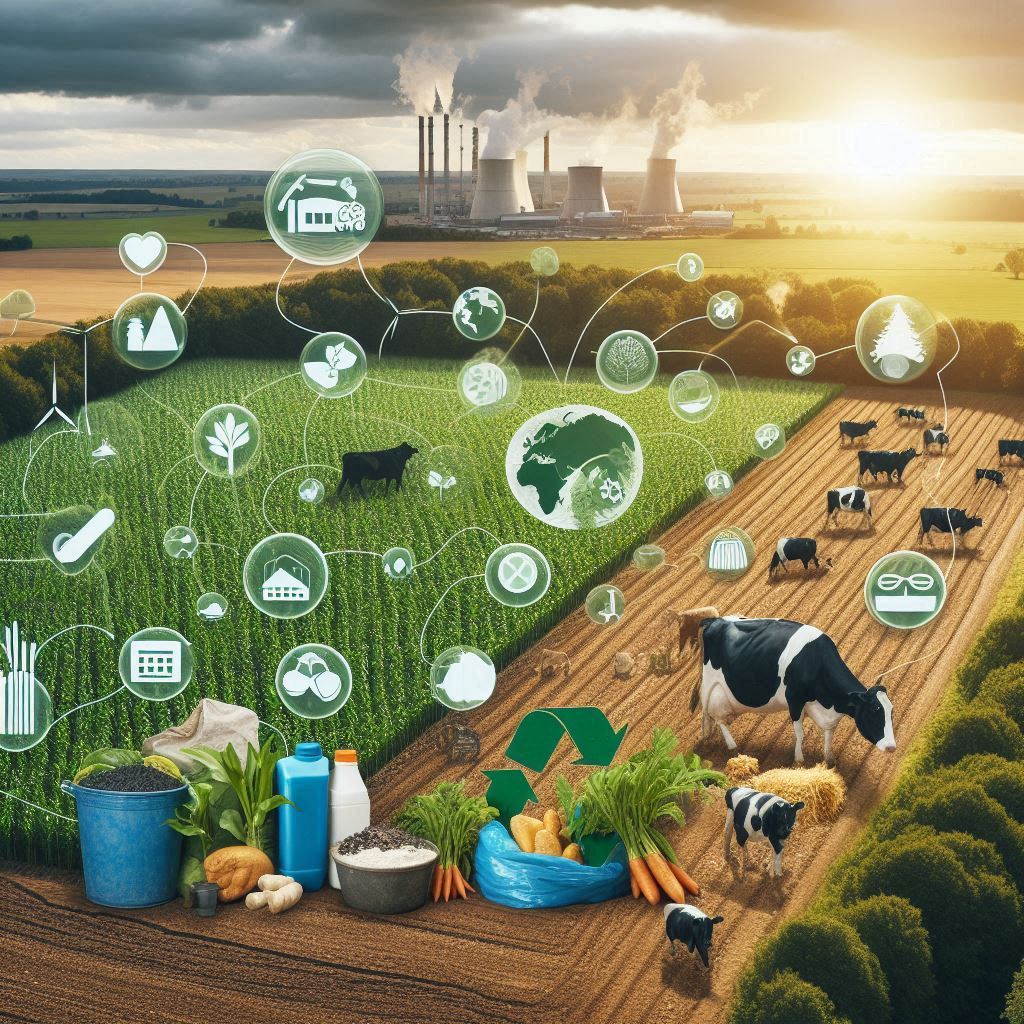
Recent discussions I have had with friends and coworkers have focused more on environmental sustainability and carbon emissions. In order to connect with the SDGs and fulfill the objectives early or on schedule, businesses and nations are becoming more mindful of the sustainability component. As a contributor, I began researching agriculture and found some fascinating information. When direct emissions from agricultural operations are taken into account, agriculture accounts for roughly 17–20% of global greenhouse gas emissions. Including Land-Use Change: Agricultural emissions account for 24–30% of global greenhouse gas emissions when land-use change emissions, such as those from peatland drainage and deforestation, are taken into account.
The amount of carbon emissions from different agricultural activities can vary significantly depending on factors such as geographical location, farming practices, crop types, soil management, and livestock types. However, based on global averages and available data, here are the approximate ranges of carbon and greenhouse gas emissions associated with different activities in agriculture:
| Activity | Carbon Emissions (Giga Tons) |
| Deforestation | 3.5-5.5 |
| Tillage and soil disturbance | 0.3-0.6 |
| Soil degradation and Poor Mgt. | 0.2-0.3 |
| Synthetic Fertilizers | 0.7-1.0 |
| Manure Management | 0.1-0.3 |
| Enteric Fermentation of Livestock | 2.1-2.5 |
| Manure Management for Livestock | 0.4-0.6 |
| Paddy Rice Fields | 0.5-1.0 |
| Fuel use for machinery on farm | 0.4-0.6 |
| On Farm Energy use | 0.2-0.3 |
| Agrochemical Production and use | 01.-0.2 |
| Irrigation | 0.1-0.2 |
| Post Harvest Activities | 0.3-0.5 |
| Crop residue burning | 0.1-0.2 |
| Perennial crop Mismanagement | 0.3-0.5 |
| Food loss & Waste | 2.1-2.2 |
1. Land-Use Change and Deforestation
Deforestation for Agriculture: Accounts for about 10% of global greenhouse gas emissions, primarily from the release of CO₂ stored in trees and soil.
Peatland Drainage: Responsible for around 5% of global agricultural emissions; peatlands release significant CO₂ when drained for agriculture.
2. Soil Management and Cultivation
Tillage and Soil Disturbance: Contributes 2-5% of agricultural emissions through the release of CO₂ from organic matter breakdown in soils.
3. Fertilizer Application
Synthetic Fertilizers: Nitrous oxide (N₂O) emissions from fertilizer use account for about 20% of agricultural GHG emissions.
Manure Management: Produces around 4-5% of agricultural emissions, mainly methane (CH₄) and nitrous oxide (N₂O).
4. Livestock Management
Enteric Fermentation: Responsible for nearly 40% of agricultural GHG emissions globally, producing methane (CH₄) from the digestive processes of ruminants.
Manure Handling and Storage: Generates about 10% of agricultural emissions, mainly methane (CH₄).
5. Rice Cultivation
Paddy Fields: Methane (CH₄) emissions from rice paddies contribute around 10% of total agricultural emissions due to anaerobic decomposition in flooded fields.
6. Energy Use in Agriculture
Fuel for Machinery and On-Farm Energy Use: Accounts for approximately 3-5% of agricultural emissions through the burning of fossil fuels for machinery and infrastructure.
7. Agrochemical Production and Use
Pesticides and Herbicides: Emissions from production and application are relatively low compared to other activities, contributing around 1-2% of agricultural GHG emissions.
8. Irrigation
Water Pumping and Distribution: Contributes around 1% of agricultural emissions, primarily CO₂ from fuel-powered pumps.
9. Post-Harvest Activities
Processing, Storage, and Transportation: Represents 2-3% of agricultural emissions, mainly CO₂ from energy use.
10. Waste Management
Crop Residue Burning: Can contribute up to 3% of agricultural emissions, releasing CO₂, methane (CH₄), and nitrous oxide (N₂O).
11. Food Loss and Waste
Supply Chain Waste: Accounts for about 8-10% of total agricultural emissions, including energy and resources used to produce, process, and transport wasted food.
Overall, the most significant contributors to carbon emissions in agriculture are deforestation, livestock management, and fertilizer application. These activities combined account for the majority of greenhouse gas emissions from the agricultural sector. I will cover on the topic what we could we to minimize the emissions


Leave a Reply